
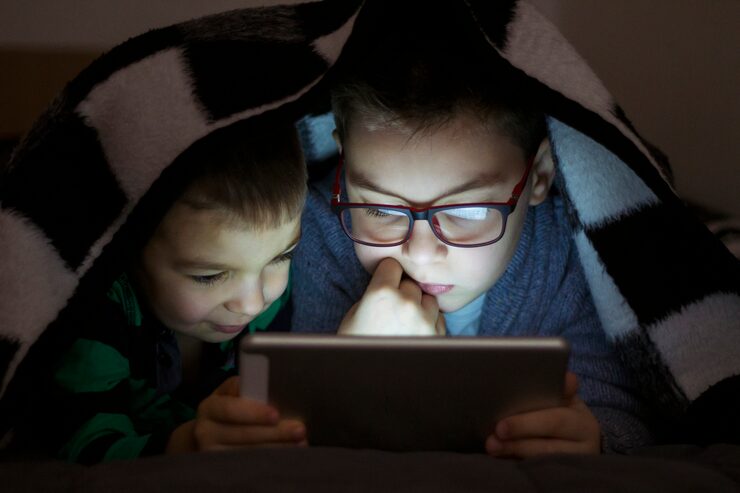
For a decade, “screen time” advice for parents boiled down to a single number: two hours a day, no more. In early 2026, the American Academy of Pediatrics released its first major screen time update in ten years — and the headline change isn’t a new number at all. It’s the removal of the strict time limit altogether.
Why the AAP Moved Away From a Fixed Number
The original 2016 guidelines were built largely around research on passive TV viewing — a very different kind of screen use than a child today doing homework research, video-chatting a grandparent, or playing an interactive learning app. Pediatricians involved in the update have been candid that translating decade-old research into today’s much more varied digital landscape had become genuinely difficult, which is part of why the new guidance shifts toward context and quality rather than a single hard cutoff.
The New Framework: The 5 Cs
Instead of a strict hour limit, the AAP now encourages parents to evaluate screen use through five questions, often summarized as the “5 Cs”:
- Child: who is your child, specifically — how do they personally respond to media, and what’s actually motivating their use of it?
- Content: what are they actually watching or engaging with — passive scrolling and an interactive, age-appropriate app aren’t treated the same.
- Calm: is a screen being used to genuinely engage a child, or mainly to manage a meltdown or fill a quiet moment?
- Crowding out: is screen use displacing sleep, physical activity, or face-to-face family time — this is the core test of whether screen use has become a problem.
- Communication: are parents talking with their kids about what they’re watching, playing, and posting, rather than just monitoring silently?
What the Age-Based Numbers Still Look Like
Even with the shift away from a single strict rule, the AAP and World Health Organization still offer age-based starting points, and they remain fairly consistent with earlier guidance for the youngest children:
- Under 18 months: avoid screens entirely, with one common exception — live video chat, such as a video call with a grandparent.
- Ages 2 to 5: roughly one hour per day of high-quality, ideally co-viewed content.
- School-age children: no fixed AAP number, but many pediatricians suggest keeping recreational (non-educational) screen time under about two hours on school days, while distinguishing that from homework or creative use.
- Teens: the focus shifts further from a time limit toward whether screen use is crowding out sleep, in-person relationships, or schoolwork.
Why This Matters More Than the Old Rule
A rigid two-hour cutoff never actually accounted for the difference between a child doing 30 minutes of coding practice and 90 minutes of homework research, versus a child passively scrolling for two straight hours. The updated framework is meant to help parents make that distinction consciously, rather than treating all screen time as interchangeable just because it’s measured in the same unit of minutes.
This kind of intentional, developmentally-aware approach fits naturally alongside the broader habits covered in our guide to parenting tips that help children thrive every day, where consistency and communication matter as much as any specific rule.
Practical Habits That Still Hold Up Regardless of Age
- Device-free bedrooms: removing screens from bedrooms, especially in the hour before bed, is consistently cited as one of the single highest-impact rules for protecting sleep.
- Device-free meals: for the whole family, not just the kids — modeling matters more than most parents expect.
- Set limits before the screen turns on: agreeing on a stopping point in advance is far more effective than negotiating once a device is already in hand.
- Replace, don’t just remove: a limit tends to fail without an alternative activity ready to fill the gap — boredom needs somewhere to go.

The Bottom Line
The 2026 update doesn’t mean screen time no longer matters — it means the old single-number rule was always an oversimplification of something genuinely more nuanced. Judging screen use by what’s actually happening during it, and what it’s displacing, gives parents a more realistic tool than a stopwatch ever did.
For the full official guidance, the American Academy of Pediatrics’ screen time Q&A is the authoritative source parents can reference directly.